Hollow Wins | Bakugo W
First blog post. I’ve been putting this off forever and I figured if I keep waiting for the “right” first post I’m never going to start. So here we go. And ofc it’s about anime. Or is it.
My Hero Academia finished recently. The whole thing, done. And while I was building this site (like literally in the middle of coding it) I quoted a Bakugo scene to the AI helping me build it because it was stuck in my head and I had nowhere to put it. That’s kind of why this blog exists. I need somewhere to put things.
So. The Great Explosion Murder God Dynamight. Let’s talk about him. What he was, what he refused to become, and what he grew into. And why I think about him every time I sit through a meeting where nothing happens and everyone leaves feeling productive.
Everyone thinks Bakugo is the angry rival character. The one-dimensional hater. The guy who screams DIE as a greeting and told Midoriya to jump off the roof in episode one. And yeah, he’s all of that. He’s also, in my mind, the one true genius of MHA and the character with arguably the most growth in the entire series (maybe Endeavour and Hawks are up there too? I don’t know. Bakugo’s different.)
Here’s what I don’t see discussed much.
He saw Midoriya. From the start. When they were kids, before quirks, before UA, before any of it. Bakugo watched this quirkless nobody run toward danger every single time while everyone else stood there. Including Bakugo, who had the most flashy quirk in the room. Midoriya had the spirit of a hero before he had any of the tools. And Bakugo, at like seven years old, clocked it.
That’s the whole tragedy of early Bakugo. He recognized the thing in Midoriya that All Might would eventually see. He saw the makings of the greatest hero in the kid everyone called useless. And it terrified him. Because if the weakest kid in the room has something you don’t, something that isn’t trainable, isn’t earnable, it’s just there, then what does your talent actually mean?

So he did what kids do. Buried it. Called him Deku. Useless. Bullied him constantly. He needed to convince himself Midoriya was weak. That was the whole point. The Vegeta playbook. Yell loud enough about being the best and maybe you’ll drown out the part of you that knows better.
And it only got worse when Midoriya inherited One For All from their shared idol and started actually becoming the thing Bakugo always feared he was. The kid he’d been putting down his whole life got chosen by the greatest hero alive. Imagine that. Imagine watching the one person you’re trying to convince yourself is beneath you get handed exactly the thing that proves he never was.
But here’s where Bakugo becomes my favourite.
He never wanted the game. He wanted to be the undisputed number one. Period. That’s it. And the distinction matters.
Sports Festival arc. Bakugo fights Todoroki in the finals. Wins. Crowd goes crazy. Podium moment. And Bakugo is literally chained to the post, muzzled, refusing the medal. Because Todoroki held back. Used half his power. The win wasn’t real.
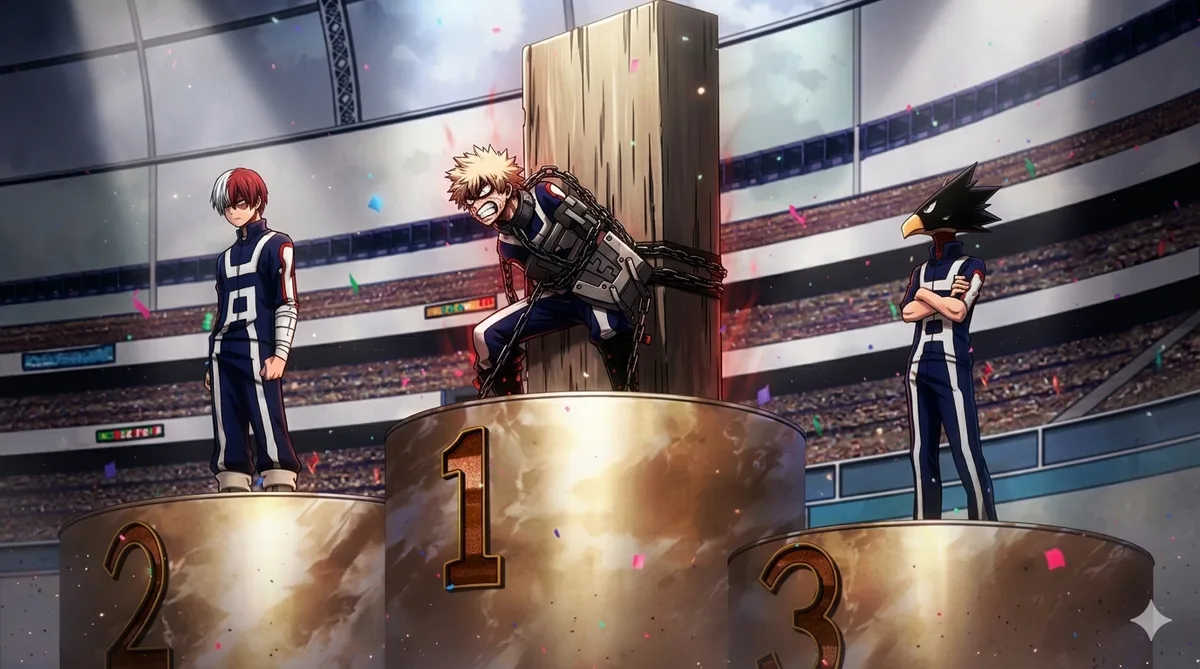
Everyone in that stadium would’ve taken the W. Your opponent sandbagged? That’s his problem. You won. Move on. Put it on the resume.
Bakugo didn’t want the resume line. He wanted to know. Not be told. Not be ranked. Know.
Dude, I see them all around me. People who take the hollow win, every single time.
The cc-all email at 9 AM to “just flag” something that doesn’t need flagging. Nobody’s solving anything, everyone’s just making sure their name shows up. The meetings where four people talk for an hour and nothing gets decided but everyone feels productive. The accountability-free, pass-the-parcel, performance-for-optics game where everyone’s fingerprints are on everything so nobody’s responsible for anything.
That’s the game. And it works. Someone once told me, dead serious, “it doesn’t matter who does the work, it matters who presents it.” And the worst part is, he wasn’t wrong. You can build a whole career on visibility. Send the right emails. Restate what someone smart said but with better posture. Never build anything, never fix anything, but your name is on everything.
Bakugo would rather be chained to a podium than play that shit.
And I get that. I really, really get that. It hits something that I can’t fully articulate. This gut-level revulsion at winning wrong. You’d rather lose clean than win dirty. That’s just wiring.
But Bakugo isn’t just the refusal. The growth is the best part. And it’s sneaky. You don’t notice it happening until it’s already happened.
There’s this moment early on where Midoriya wants to help rescue Bakugo from villains. But he can’t go directly. Bakugo won’t accept help from him. The pride won’t allow it. So Midoriya asks Kirishima to be the one to reach out. Literally routes through a third party because the guy who needs saving would rather stay captured than owe Deku anything.
Last season. Final battle. All Might is about to die. There’s no time for any of the bullshit. Midoriya launches Bakugo toward All For One and the only communication between them is a single glance.
One look. Bakugo goes.

Just gone. That’s the whole character arc in one frame. The kid who couldn’t accept help from Midoriya through a third party, now taking a direct launch from him on nothing but a glance.
Same loud, abrasive, zero-filter Bakugo. Just… sure of himself now. He got so good at the actual thing, at being a hero, at knowing what he is, that the ego noise went quiet on its own. He outgrew the game by being too focused on the work to notice it.
I thought I had that. I really did. I’ve kept my head down, stayed out of the politics, moved up reasonably well without playing any of it. But honestly? The impostor syndrome still hits at 2 AM. That voice. Maybe you’re not actually good enough, maybe you just got lucky, maybe sitting outside the game only works until someone who plays it decides you’re in the way. Some nights it’s loud. I wonder if everyone has it. I wonder if Bakugo did, in the scenes the show didn’t bother animating. I hope to grow out of it the way he finally did. Just be so undeniably good that the voice runs out of shit to say.
And then there’s the guy who didn’t grow out of it.
Endeavour had the same starting point. Watched someone (All Might) be the thing he wanted to be, in a way effort couldn’t close. Same wound as Bakugo. But Endeavour played the game. Chased the rankings. Was number two for twenty years and let it eat him alive. Married for quirk genetics. Destroyed his family trying to breed a kid who could surpass All Might. And when All Might finally retired? Endeavour got the number one spot by default.
The exact kind of win Bakugo chained himself to a podium to refuse. At sixteen.
Endeavour let the jealousy rot. And here’s the sick part. It became load-bearing. Career, family, legacy, all built on “I should’ve been him.” By the time he tried to fix it, the damage was structural. You couldn’t remove the spite without the whole thing collapsing. That’s terrifying if you think about it long enough.
Bakugo saw the same void. And at some point (the show never gives you one clean scene for it, which is what makes it real) he just chose to fill it differently. Stopped measuring himself against Midoriya. Started measuring himself against what he could be. That’s the difference. Endeavour is what happens when you play the game and win. Bakugo is what happens when you refuse to play and just get better.
I don’t have a clean ending for this. First post, I’m giving myself permission to not have one.
But if I’m being honest about why Bakugo stuck with me, it’s the thing about sitting outside the game. I see so much of the Endeavour sickness in professional life. People chasing titles, optimizing for optics, spending more energy on positioning than on actually being good. And it works for them. I’ve watched it work.
I’d rather just be so good it doesn’t matter. Okay, I think I’m a little above it, I’ll be honest. But more than that, I want to be outside it. Completely. Off the field entirely, getting better at the thing while everyone else is busy playing. And if you get good enough, genuinely, undeniably good enough, nobody argues with that.
Someone needs to make a proper Bakugo AMV with Imagine Dragons’ “Natural.” Because that’s what he is. The explosion quirk is cool and all, but the real thing is simpler. He never wanted anything except to earn it for real.
Anyway. First post done. More coming.
For the Nerds: How This Post Was Built
If you’re here for the anime takes, you’re done. This section is for the writing nerds who want to see the scaffolding.
Structure: Three-act Bakugo arc (the wound → the refusal → the growth) with professional life woven through, not alternating with. The Endeavour foil acts as a fourth beat — the “what if he didn’t grow” counterexample. First-post acknowledgment bookends the whole thing.
Devices used:
| Device | Where | What it does |
|---|---|---|
| Withholding | The Bakugo setup builds the wound before naming it — “He saw Midoriya” makes you figure out the tragedy before the text states it | Creates discovery in the reader |
| Mirror contrast | Kirishima rescue (early series) ↔ the glance (finale). Same dynamic, opposite response. The distance between these two moments IS the character arc | Shows growth without explaining it |
| The Vegeta parallel | One line — “The Vegeta playbook” — that carries its full weight for anyone who knows DBZ | Compression device. No explanation needed for the target audience |
| Direct address | ”Dude, I see them all around me” / “Imagine that.” | Breaks the fourth wall, pulls reader into the argument |
| Rule of three | ”Not be told. Not be ranked. Know.” — escalation landing on the shortest, hardest word | Rhythmic emphasis. The short final word stops time. |
| Dialogue | ”it doesn’t matter who does the work, it matters who presents it” | One line of overheard speech grounds the office critique in something concrete |
| Earned personal turn | The impostor syndrome paragraph comes after ~900 words of anime. You’ve earned the right to go personal. | Emotional center of the post, placed late so it hits harder |
| Self-aware hedge | ”I think I’m a little above it, I’ll be honest” | Prevents the closer from sounding preachy. Honesty > positioning. |
| Bookend | Opens “First blog post” / closes “First post done. More coming.” | Gives first-post energy without making the whole thing meta |
What I cut: Draft v1 alternated anime and office sections in separate blocks — felt like two posts stapled together. v2 was cleaner but too polished, read like an essay. v3 integrated the professional stuff inside the anime analysis and loosened the voice. Killed 8 “not X, but Y” negative parallelisms that were becoming a tic.
The hardest part: Getting the impostor syndrome paragraph right. Too much and it’s self-pity. Too little and it’s posturing. “Some nights it’s loud” was the line that cracked it — factual, not performed.